
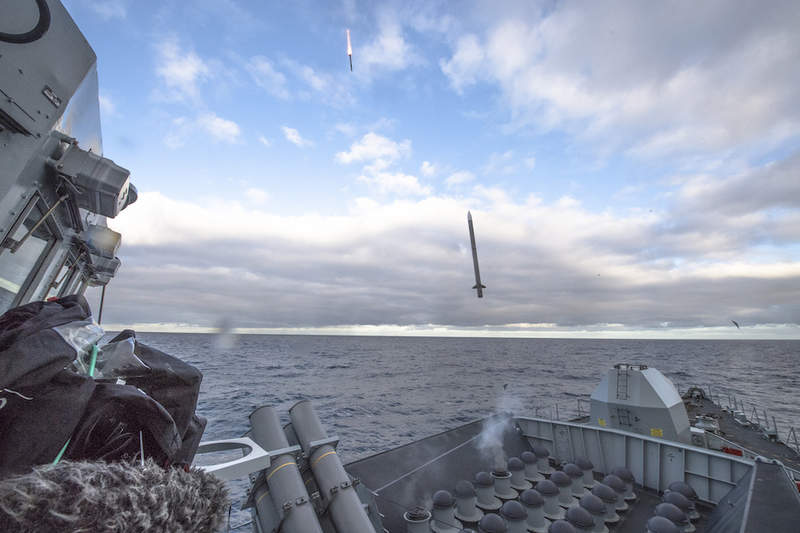
The British Royal Navy has successfully conducted Sea Ceptor air defence missile system tests aboard two of its Duke-class Type 23 frigates, HMS Argyll and HMS Westminster.
The firing trials from HMS Argyll were conducted to test the weapon system upgrade and confirmed that the missile system is able to proceed to the next stage of acceptance into navy service.
Go deeper with GlobalData


Discover B2B Marketing That Performs
Combine business intelligence and editorial excellence to reach engaged professionals across 36 leading media platforms.
Royal Navy personnel will be able to use the Sea Ceptor to defend against a number of airborne targets such as hostile combat jets, enemy helicopters and missiles travelling at supersonic speeds.
The weapon system was first test-fired from HMS Argyll against single aerial targets, followed by more demanding tests such as a single target engaged by two missiles, as well as a twin firing that saw two targets each engaged by a single missile simultaneously.
In addition, another test firing was performed by the Royal Navy on-board its second frigate, HMS Westminster.
HMS Westminster anti-air-warfare officer lieutenant Nick Andrews said: “HMS Westminster managed to explore the real potential of the system during her training, and to say it is a real game changer is an understatement.

US Tariffs are shifting - will you react or anticipate?
Don’t let policy changes catch you off guard. Stay proactive with real-time data and expert analysis.
By GlobalData“Unlike its predecessor, the system is capable of defending ships other than Westminster herself.
“Whether it’s engaging multiple air threats or fast incoming attack craft, Sea Ceptor represents a massive capability upgrade for the Type 23 frigate.”
Sea Ceptor was manufactured by MBDA and has been designed to replace the traditional Sea Wolf weapon system on-board the navy’s Type 23 frigates.
Furthermore, the new missile system will offer the same capability for the Royal Navy’s future Type 26 frigates.
The system is equipped with the common anti-air modular missile (CAMM), which is capable of reaching speeds of up to three times the speed of sound.
Sea Ceptor will also have the capability to handle multiple targets at the same time and is able to protect an area of approximately 500m2 over land or sea.
Additionally, it can be used against small surface targets such as jet skis, speedboats and fast-attack craft when required.
UK Defence Procurement Minister Harriett Baldwin said that the work to build and install Sea Ceptor across the Royal Navy will help support the industry and create 600 jobs in the Bristol, Stevenage and Bolton areas.



