

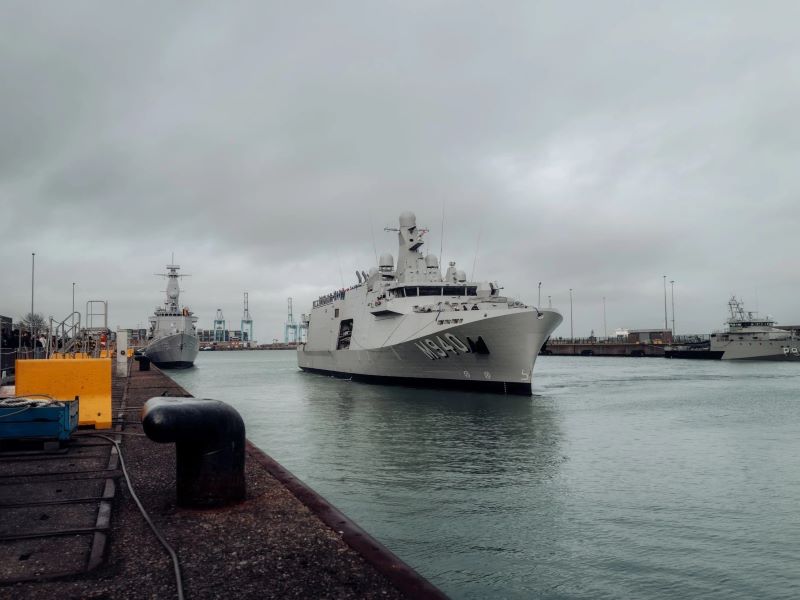
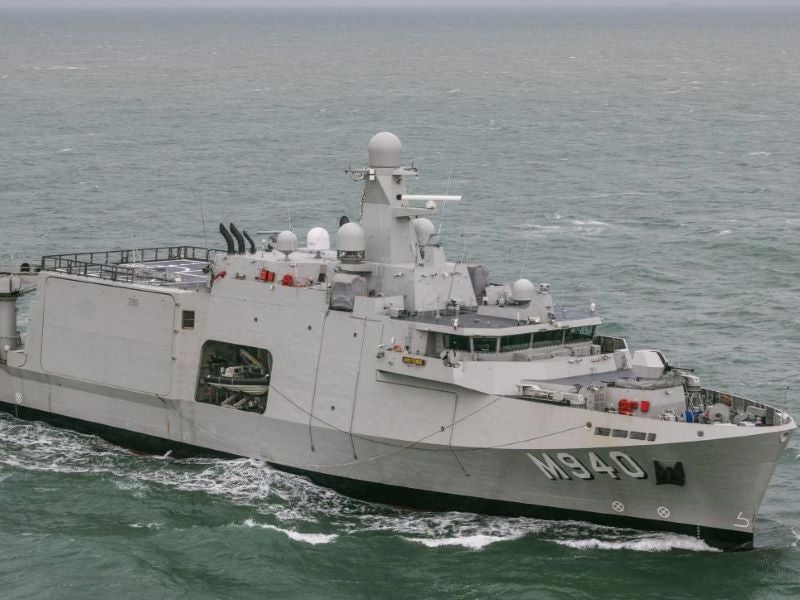
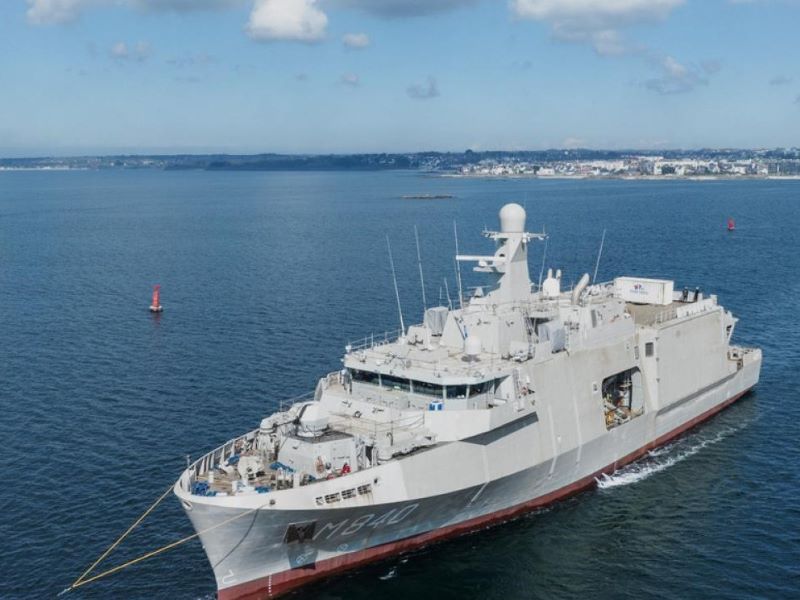
The City/Vlissingen-class mine countermeasure vessels (MCMVs) are the next-generation minehunters being offered by Belgium Naval & Robotics under the replacement Mine Countermeasure (rMCM) programme for both the Belgian Navy and the Royal Netherlands Navy.
In May 2019, the Belgium Naval & Robotics consortium, comprising Naval Group and ECA Group, was awarded a €2bn ($2.4bn) contract to deliver 12 MCMVs, six each for the Belgian and the Netherlands. ECA Group merged with iXblue in October 2022, forming Exail, a new joint brand.
Recommended Buyers Guides

The new vessels will replace the Tripartite-class minehunters operated by both countries for the past 30 years.
The MCMVs are suitable for a range of missions including identification and destruction of naval mines, anti-piracy, anti-terrorism, maritime traffic interception and territorial waters surveillance.
The Belgian Navy’s six City-class vessels are named Antwerpen, Brugge, Liège, Oostende, Rochefort and Tournai.
The Royal Netherlands Navy’s six Vlissingen-class vessels are named Delfzijl, Harlingen, Ijmuiden, Scheveningen, Schiedam and Vlissingen.
The first of the 12 mine countermeasures vessels under the rMCM programme, Oostende, was delivered to the Belgian Navy in November 2025.
All vessels being developed under the programme are expected to be delivered by 2030.
City/Vlissingen-class MCMV development
Naval Group and ECA Group exhibited the MCMV prototype during PACIFIC 2019 in Australia in October 2019.
In November 2019, Naval Group completed the testing of the MCM mothership launch and recovery system (LARS) at the Maritime Research Institute Netherlands in Wageningen, Netherlands.
Belgium Naval & Robotics passed the systems functional review for the MCMV programme in May 2020, validating the functional and architectural studies of all the systems.
The first vessel of the programme intended for the Belgian Navy, Oostende, was launched in April 2023.
The keel for the Belgian Navy’s second vessel, Tournai, was laid in March 2023. The keel for the third vessel, Brugge, was laid in February 2024, and the vessel was launched in May 2025.
The keel for the fourth vessel, Liège, was laid in January 2025, and the keel for the fifth vessel, Antwerpen, was laid in January 2026.
The Dutch Navy’s first vessel, Vlissingen, was launched in October 2023 and began its initial sea trials from Concarneau, France, in March 2025.
Construction on the Royal Netherlands Navy’s third vessel, Ijmuiden, began in June 2024, and on the seventh vessel, Delfzijl, in October 2024, while the fourth vessel, Scheveningen, was launched in November 2024.
MCMV design and features
The new generation Dutch Belgian MCMVs design features an overall length of 82.6m, a beam of 17m and a displacement of 2,800t. The vessels can carry a total of 63 crew members.
The vessels will be integrated with a LARS for the on-board INSPECTOR 125 unmanned surface vehicles.
The ships can carry up to 100 drones, which are managed in a pool called Toolbox that can be configured based on the mission-specific requirements.
Weaponry
The new generation Dutch and Belgian MCMVs are being equipped with two Sea deFNder remote weapon stations mounted with manned 12.7mm FN M2HB-QCB machine guns.
The vessels are fitted with Naval Group’s Polaris combat management system. Their drone suite includes Exail’s UMISOFT architecture, with two Exail Inspector 125 unmanned surface vessels and three A-18 autonomous underwater vehicles equipped with Exail UMISAS 120 sonar.
The package also features two T-18 towed sonars carrying Exail UMISAS 240 sonar, along with two mine identification and disposal systems, namely Exail Seascan and K-Ster C.
An unmanned aerial vehicle (UAV) is provided via UMS Skeldar’s V200. For influence minesweeping, the vessels use an Exail system integrating five CTM magnetic modules and one PATRIA acoustic module.
Embarkation capacity includes two 7m SOLAS-compliant rigid hull inflatable boats.
For launch, recovery and handling, the vessels have two side launch and recovery systems suitable for surface drones or commando craft, supported by a dedicated 15t crane in the stern and a 3t overhead crane.
NS50 radar on board MCMVs
The NS50 radar offers self-protection capability to the vessels against airborne and surface threats. The fully software-defined sensor helps in providing dual functions between air and surface surveillance, along with fire control capability.
The radar also enables the crew to evaluate the threat and deploy countermeasures to safeguard the ship.
It is the world’s most compact, affordable 4D multi-function naval radar with high-performance air and surface detection, tracking and classification capabilities.
Propulsion and performance
The MCMV minehunters are being powered by two 6DZC motors and a 12VDZC generator set, providing a maximum speed of 15.3 knots and a range of more than 3,500 nautical miles.
Contractors involved
As the overall architect and prime contractor, Naval Group is responsible for the vessel design, system integration, and the testing and commissioning of the mission suite, including the combat and mine countermeasures systems.
Kership, a joint venture between Naval Group and Piriou, is responsible for overseeing the construction of the 12 ships.
Thales was awarded a contract to deliver its NS50 radar for the MCMVs in January 2021.
Naval Group and Kership selected Balino for new lines of tail shafts and main propellers for the MCMVs. Brusselle Carral is responsible for supplying the deck equipment for the ships.
Exail is responsible for the delivery of the Toolbox elements, which are being produced at a plant in Ostend, Belgium. It awarded a procurement contract to UMS SKELDAR for supplying the SKELDAR V-200 UAVs in July 2020.
Naval Group and Kership selected ABC and FN Herstal for propulsion and combat systems, respectively.
ENGIE Solutions was selected to install the heating, ventilation and air-conditioning systems and cold rooms for the 12 MCMV minehunters.
Most mechanical parts and sub-assemblies are being manufactured at Flanders Ship Repair shipyards, which will also provide maintenance services for the minehunters.
