
ANELLO Photonics has won the Innovation and Product Launches awards in the 2025 Naval Technology Excellence Awards for its work in assured positioning, navigation, and timing (PNT). The company’s silicon photonic optical gyroscope platform, SiPhOG™, and its ANELLO Maritime INS, which won the awards, bring solid-state, GPS-resilient navigation into operational service, addressing a growing need to maintain reliable positioning in contested and GPS-denied environments at sea.
The company won the Innovation award in the PNT Systems category for translating its silicon photonic optical gyroscope technology into a scalable, GPS-resilient navigation layer suitable for modern naval operations. It received the Product Launches award in the Inertial Navigation category for introducing the ANELLO Maritime INS, a purpose-built, solid-state inertial navigation system designed to maintain reliable course-keeping and positioning for commercial and defense maritime applications even under GNSS stress.
Go deeper with GlobalData


Discover B2B Marketing That Performs
Combine business intelligence and editorial excellence to reach engaged professionals across 36 leading media platforms.
Innovation in PNT Systems: Silicon photonics as a scalable assured navigation layer
The Innovation award recognizes ANELLO’s effort to turn silicon photonics from a promising technology into an operational PNT layer that is directly applicable to naval missions. In practice, this means addressing a well-understood problem: GNSS has become an increasingly fragile cornerstone for navigation, particularly in congested and contested waters where jamming and spoofing are now routine concerns. ANELLO’s SiPhOG™ platform is designed to keep platforms navigationally coherent when external signals are compromised, rather than treating inertial navigation as a secondary backup.
At the heart of this platform is the Silicon Photonic Optical Gyroscope – SiPhOG, which replaces traditional mechanical and MEMS gyroscopes with a solid-state photonic design. Conventional systems often rely on moving parts or fiber-based architectures that, while mature, carry known constraints in terms of maintenance, reliability, and scalability. By shifting to integrated silicon photonics, ANELLO removes moving mechanical assemblies and seeks to simplify the physical architecture of the gyroscope. This provides a pathway to higher mean time between failures, fewer wear-related issues, and a more predictable lifecycle profile—critical considerations for the Navy sustaining complex fleets at sea over long durations.

A key reason this work stands out in the PNT Systems category is the way ANELLO has linked advanced physics with industrial practicality. Silicon photonics is not simply used as a niche, high-end sensor; instead, the company has developed proprietary photonic chipsets in the United States with an eye toward miniaturization and repeatable, volume-oriented manufacturing. This matters because assured PNT has historically been concentrated on a small number of high-value platforms. By focusing on compact, manufacturable photonic cores, ANELLO positions its technology for broader deployment across large fleets, including smaller ships, auxiliary vessels, and unmanned systems, rather than just flagship combatants.
This scalability is supported by low size, weight, power, and cost (SWaP-C) characteristics. The SiPhOG™-based hardware is designed to fit into platforms that cannot accommodate bulky or power-hungry systems, such as USVs and UUVs, without forcing trade-offs in payload or endurance. In addition, the cross-domain applicability—land, air, and sea—allows defense organizations to consider a more standardized navigation layer across multiple services, simplifying integration and sustainment over time.
Another aspect central to the Innovation award is the integration of AI sensor fusion and spoofing discrimination as native functions. Rather than treating inertial data, GNSS information, and other sensor inputs as separate streams that must be reconciled elsewhere, the ANELLO SiPhOG™ platform embeds an AI engine capable of fusing data in real time. This engine is tuned to cope with dynamic operating environments, particularly at sea where signal conditions can shift quickly and where GNSS interference may be intermittent or deliberately manipulated.
In operational terms, this means the navigation system can transition smoothly between full GNSS support and inertial-dominant modes without abrupt loss of performance. When GNSS signals are jammed or spoofed, the ANELLO system detects these anomalies and falls back on inertial measurements, maintaining continuity of heading and position estimates. Once the system determines that GNSS is working properly, ANELLO rapidly realigns to the trustworthy GNSS inputs. This capability directly addresses concerns about GNSS dependence in modern fleets and reduces the risk that a single point of failure in external signals will compromise mission execution.
Finally, the SiPhOG™ platform has been engineered with harsh environments in mind, including defense and demanding commercial contexts. This includes the ability to function under vibration, temperature variations, and other stressors typical of naval operations. Real-world deployments and demonstrations show that the ANELLO SiPhOG platform performs successfully not just in controlled tests, but in real GPS-denied and contested environments too.
Product launch excellence in inertial navigation: ANELLO Maritime INS for contested seas
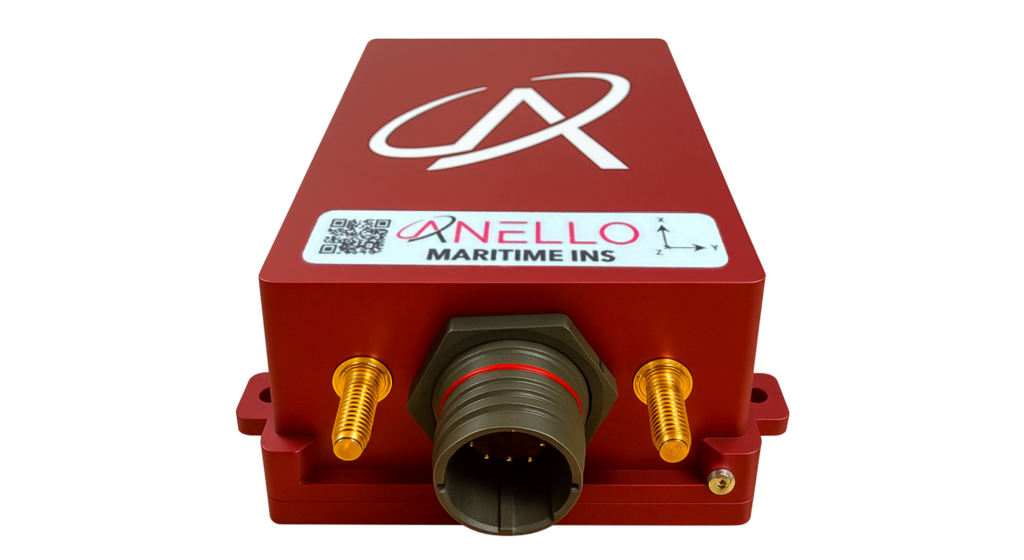
The ANELLO Maritime INS was introduced in 2025 as the first maritime navigation system built specifically on the SiPhOG™ platform. A central performance characteristic of the Maritime INS is its three-axis SiPhOG™ core with less than 0.5° per hour unaided heading drift. For blue-water operations, this level of drift is a key metric: it determines how long a vessel can rely on inertial navigation alone before errors become operationally significant. In practical fleet terms, being able to maintain acceptable heading accuracy for extended periods without external fixes offers a degree of resilience when GNSS access is unreliable or deliberately denied. This is relevant especially for long-endurance missions, operations in high-interference regions, and autonomous or minimally manned platforms that cannot rely on frequent manual corrections.
The Maritime INS integrates two triple-frequency GNSS receivers, providing both redundancy, heading determination and improved robustness when satellite signals are available. Triple-frequency capability allows the system to take advantage of modern GNSS services and improves resistance to certain interference and atmospheric conditions. The dual-receiver design supports static heading determination and gives operators an additional layer of assurance that if one receiver experiences issues, the other can help sustain service continuity.
Layered on top of this is the ANELLO AI Sensor Fusion Engine, which coordinates inertial data, GNSS inputs, and other relevant sources, and includes GNSS spoofing detection. The emphasis on spoofing detection is notable. While jamming has long been considered a threat, spoofing adds the problem of potentially plausible but false signals. By incorporating spoofing detection in the core navigation product, rather than leaving it as an external analytic function, the ANELLO Maritime INS is structured to help operators distinguish between absence of signal and the presence of manipulated data. This is directly aligned with operational concerns in contested maritime regions, where navigation systems must not only survive interference but also avoid being misled by it.
From an integration and logistics standpoint, the Maritime INS is packaged with low SWaP requirements—drawing less than 6 W and housed in a compact, lightweight form factor. For naval programs, particularly those adding navigation upgrades to existing hulls or equipping small unmanned platforms, this reduces barriers to adoption. It allows the system to be considered as a retrofit option across existing fleets, as well as a straightforward fit for newbuild designs, without requiring substantial changes to power distribution or internal layouts. These accelerated installation and cross-fleet applicability features are important considerations for operators looking to enhance navigation resilience without major refits.
Environmental robustness is another reason the ANELLO Maritime INS was recognized. The system is IP68-rated, providing full protection against water ingress, and is designed to withstand corrosion, salt spray, shock, vibration, and chemical exposure. These qualifications are essential for deployment on exposed decks, in machinery spaces, or on small unmanned craft that experience harsher motion profiles and may be more exposed to the elements. The solid-state nature of the SiPhOG™ core—lacking moving parts—supports reduced maintenance demands and lowers the likelihood of failures induced by persistent vibration or shock.
The product has also been tested in conditions that reflect real naval use, including trials and early deployments where it demonstrated precise navigation in GPS-denied or highly contested waters. Reports of GNSS-denied course-keeping and mission continuity confirm that the system’s performance extends beyond specification sheets and into practical operation.
By combining a high-precision inertial core, dual triple-frequency GNSS, embedded spoofing detection, low SWaP packaging, and maritime-grade environmental protection, the ANELLO Maritime INS translates the SiPhOG™ innovation into a concrete solution tailored for naval users.

“Being selected for the Naval Technology Excellence Awards is a powerful validation of ANELLO’s silicon-photonics technology, innovation and solutions such as our Maritime INS. In GPS-denied or contested waters, resilient navigation isn’t a nice-to-have – it’s mission critical. We’re honored by this recognition and excited to continue to support customers that need precision, reliability, and trust at sea.”
– Mario Paniccia PhD, CEO, ANELLO Photonics
Company Profile
ANELLO Photonics is a leading developer of inertial navigation solutions in GPS-denied environments. The ANELLO solutions are based on the disruptive SiPhOGTM (Silicon Photonics Optical Gyroscope) that provides accuracy and reliability paired with an unprecedented reduction in cost and SWaP (size, weight and power) footprint.
ANELLO offers state of the art Inertial Navigation Systems (INS) and Inertial Measurement Units (IMU) that are meticulously crafted to meet the requirements of challenging operations in GPS-denied environments.
ANELLO’s technology portfolio spans over 40 issued patents, over 44 pending patents, and also includes an AI-based sensor fusion engine. ANELLO® and SIPHOGTM are registered trademarks of ANELLO Photonics. ANELLO’s solutions excel in meeting the rigorous navigation and positioning demands of autonomous applications across Maritime, Construction, Trucking, Drones/UAVs, Automotive, Agriculture and Defense sectors.
Contact Details
Links
Website: https://www.anellophotonics.com/


