
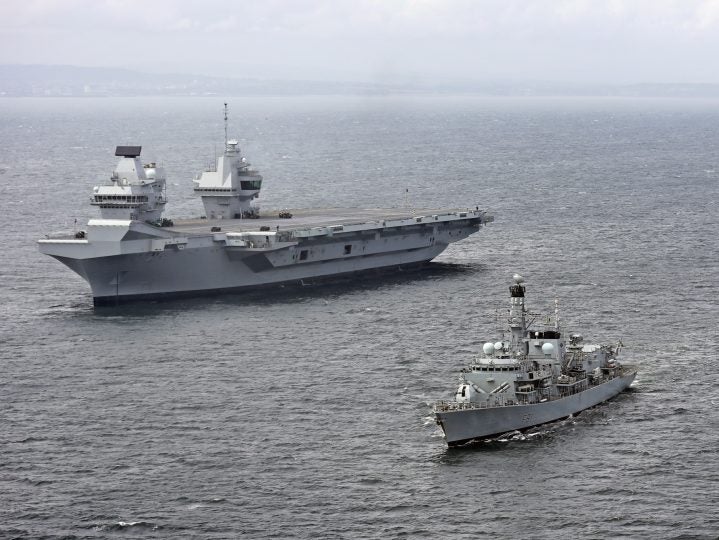
The Royal Navy has awarded QinetiQ an £18.7m Operational Assessment of Signatures Informing Susceptibility (OASIS) contract to reduce the acoustic and electromagnetic signatures of ships and submarines.
Maritime vessels are susceptible to detection due to the ambient signature given off by machinery such as ship’s engines, propellers and pumps. Bubbles created by propellers and water displaced by the hull of a ship as it travels also give off acoustic signatures. Reducing the noise signature will make vessels less easy to detect and help to protect them from a range of attacks.
Go deeper with GlobalData


Discover B2B Marketing That Performs
Combine business intelligence and editorial excellence to reach engaged professionals across 36 leading media platforms.
Royal Navy Commodore Martyn Williams said: “The ability to maintain an in-depth knowledge of a ship or submarine’s acoustic and electromagnetic signature is an essential part of maintaining a battle-winning edge – we can see them before they see us.
“But it is more than that. The data we collect today will inform the fleet of tomorrow and give us the information we need to respond to new threats at pace.”
QinetiQ will provide ‘over a dozen services’ through an existing long-term partnering agreement (LTPA), a 25-year contract to provide the Ministry of Defence (MOD) to provide support for the development of new technologies. QinetiQ and the MOD this year signed a £1.3bn amendment to the LTPA to ensure further development and investment.
QinetiQ managing director of maritime, land and weapons Steve Fitz-Gerald said: “In a world where the pace of technological change is increasing and those that would wish the UK harm have access to ever more sophisticated equipment, it is vital that the Royal Navy is able to protect its fleet of warships and the women and men who serve on them.
“We are making a massive investment to create a modernised LTPA and the OASIS contract will be able to turn this investment into real value for our customers. Teams across QinetiQ continue to play a significant role in the modernisation of UK test and evaluation and development of capability for our forces.”
The Royal Navy will use signature detection capabilities including underwater radiated noise, radar cross-section, target echo strength and electromagnetics to build a picture of vessels signatures. The navy will store information in its Maritime Knowledge Management (MKM) system and use the information to aid its decision-making.
Modern torpedoes can detect and distinguish between different vessels, reducing the chances of friendly fire and allowing the torpedo to target the highest value ship in a fleet. Dampening acoustic signatures of vessels makes it easier to protect navies’ capital ships from attack.
QinetiQ’s precursor, the Defence Evaluation and Research Agency, has in the past looked to develop reduced noise signature ships for the Royal Navy with its Research Vessel Triton. The Triton utilised a trimaran (three-hulled) designed to reduce a smaller acoustic signature.


