
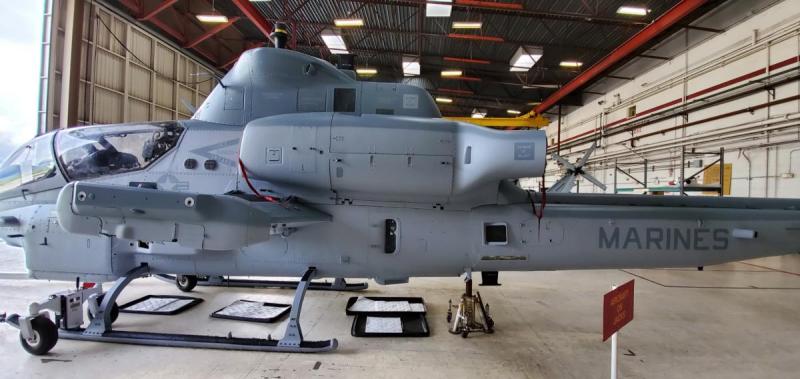
The US Naval Research Laboratory (NRL) has developed a sustainable topcoat free of harmful isocyanates and other hazardous air polluting (HAP) chemicals for navy and marine aircraft.
The environmentally and user-friendly topcoat developed by NRL chemists was recently applied onto the exterior of a US Navy F/A-18 Hornet and Marine Corps UH-1Y Venom and AH-1Z Viper helicopters.
Go deeper with GlobalData

Discover B2B Marketing That Performs
Combine business intelligence and editorial excellence to reach engaged professionals across 36 leading media platforms.
This new topcoat is a one-component (1K) polysiloxane based on organosilane polymers. Isocyanates and HAPs are found in two-component (2K) polyurethane topcoats currently applied to the Department of Defense (DoD) and commercial aircraft.
Exposure to isocyanates can cause several health problems that include irritation of the skin and mucous membranes, chest tightness, and difficulty breathing. HAPs are known to cause cancer and other health hazards.
NRL senior research chemist Erick Iezzi said: “Polyurethane topcoats have existed for several decades, yet within a few years we’ve been able to develop an environmentally friendly alternative that provides similar laboratory performance and is easy for painters to use.”
The 1K polysiloxane topcoat on the US Navy and Marine Corps aircraft is scheduled for an evaluation period of one to two years.
Using polysiloxane instead of isocyanates ensures safety for painters and personnel conducting maintenance in surrounding areas.
The topcoat eliminates the requirement for metering or mixing of components as all chemicals are in a single container.
This reduces the time of preparation and ensures a consistent colour on aircraft.
Explaining the demanding nature of developing aircraft coatings, Iezzi said: “Aircraft have aluminium skin, which means the coating must provide greater flexibility, especially at cold temperatures during high-altitude flight. An aircraft topcoat must also retain a camouflage appearance for longer periods of time.”
The topcoat application was sponsored by the DoD’s Environmental Security Technology Certification Program (ESTCP).
The 1K polysiloxane topcoat was developed by NRL’s Center for Corrosion Science and Engineering.



