
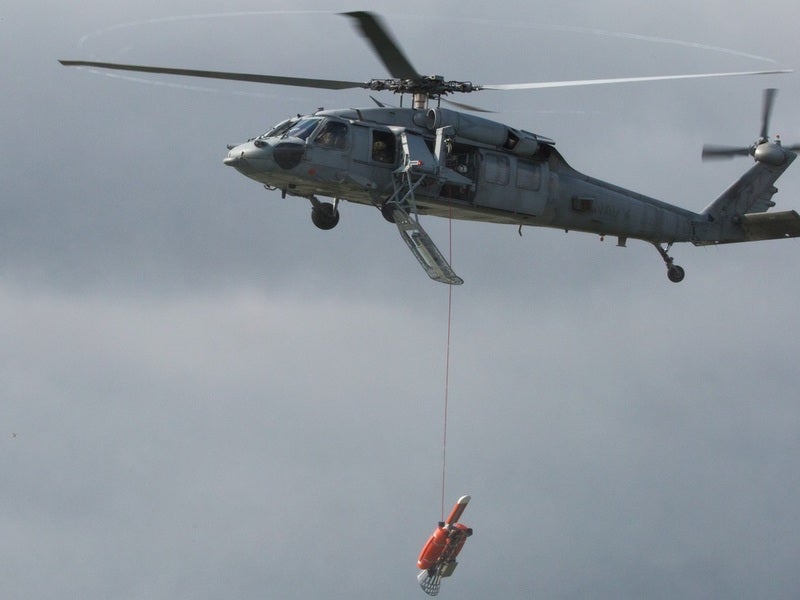
Engineers at Naval Surface Warfare Center Panama City Division (NSWC PCD) have tested a drone designed to ensure the protection of navy personnel during mine hunting and clearing missions.
Known as the Airborne Surface Quad Thruster Interface Device (ASQUID), the device will eliminate the need for personnel to enter a minefield during mine hunting and clearing missions.
Go deeper with GlobalData


Discover B2B Marketing That Performs
Combine business intelligence and editorial excellence to reach engaged professionals across 36 leading media platforms.
The NSWC PCD team performed a flight test using the device, which attaches to the side of an MH-60 helicopter.
Once the helicopter reaches the right location, ASQUID lowers the MK-18 drone into the water to search for mines, according to NSWC PCD Aviation Systems technical programme manager Tim Currie.
Following completion of the mine sweep operation, the MH-60 can be brought back to the location to enable the ASQUID to retrieve the drone.
Currently, the MK-18 is delivered to minefields using a rigid-hulled inflatable boat (RHIB).
RHIBs are slow and not suitable for operation in rough waters. The existing delivery method puts sailors in close proximity to minefields.
Currie added: “This new delivery method increases the time and speed that the MK-18s are delivered.
“They are able to stay on station longer because they don’t waste their internal batteries getting to the minefield. Sailors are our most valuable asset and this new technology puts them out of harm’s way.”
The technology was developed by the NSWC PCD engineers in collaboration with Naval Underwater Warfare Center Keyport engineers. The project was funded by the Naval Innovative Science and Engineering (NISE) programme.
Meanwhile, MH-60 helicopter squadron Air Test and Evaluation (HX) 21 conducted the flight test in order to certify the design.
Currie further stated: “We wanted to make the ASQUID easy for any MH-60 crew to operate. Instead of creating our own controller, we purchased XBOX controllers, something we thought a lot of sailors would be familiar with operating.”



