

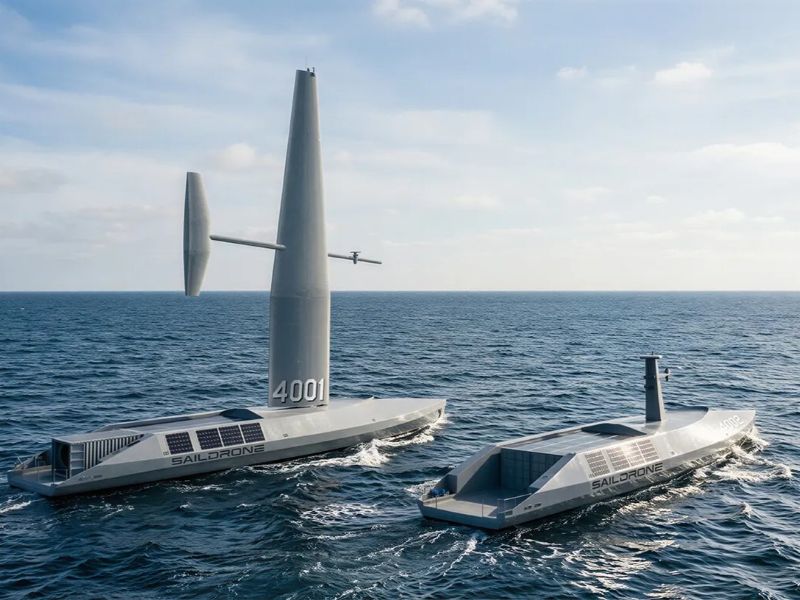
Spectre is an uncrewed surface vessel (USV) developed by Saildrone for anti-submarine warfare (ASW), high-speed operations, and low-profile kinetic strike missions.
The platform is designed to deliver effects in surface and sub-surface maritime environments while maintaining long-range endurance and a reduced acoustic signature.
Recommended White Papers

Recommended Buyers Guides

Saildrone unveiled Spectre in April 2026. The American Bureau of Shipping (ABS) has granted the platform Approval in Principle (AIP), confirming alignment with the requirements for High Speed Naval Craft certification.
The first Spectre USV is scheduled to undergo sea trials in early 2027.
Spectre design and features
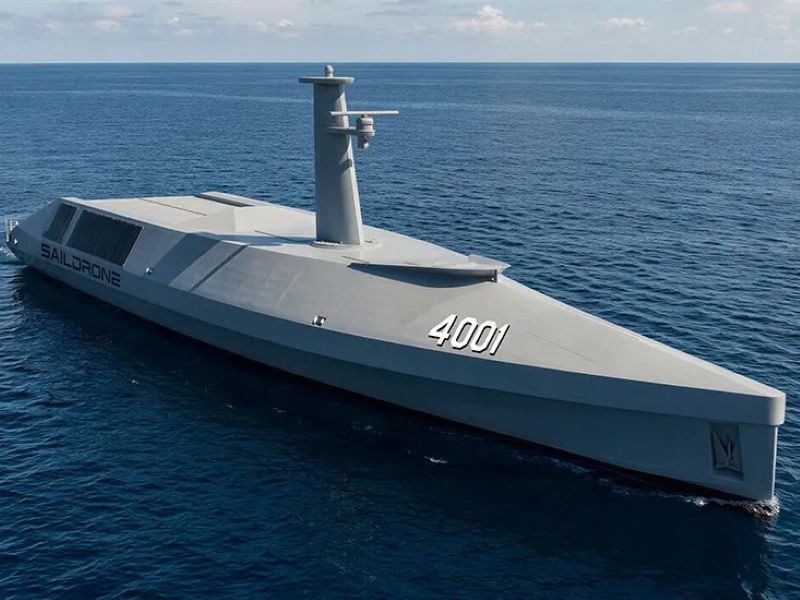
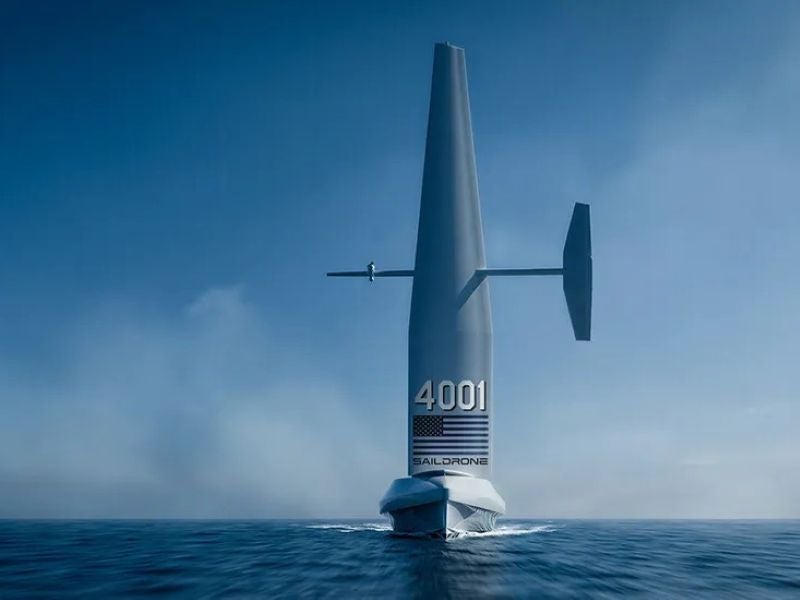
The Spectre USV has an aluminium hull measuring 52m (170ft) in length and a draft of 3.2m. Its air draft is 43m with the wing fitted and 8m without the wing.
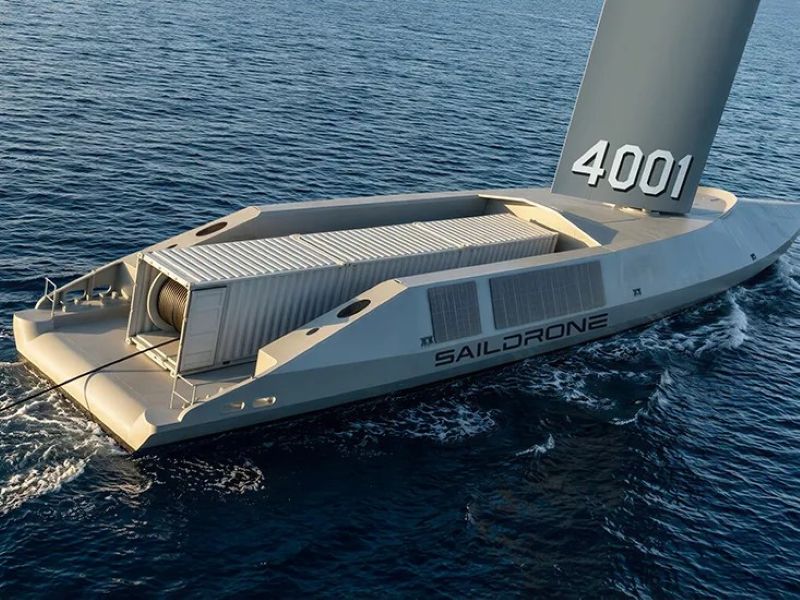
The vessel is intended to accommodate containerised payloads for deployment with fleet operations across multiple theatres, including systems for undersea sensing and response. It has a maximum payload capacity of more than 70 tonnes (t) and provides 250kW of dedicated payload power. The concealed payload deck can accommodate two 40ft containers, five 20ft containers, or a configurable combination of specialised mission modules.
The platform’s low position relative to the waterline supports payload deployment over the transom. Bulwarks protect onboard equipment against observation and sea spray during high-speed operations in adverse weather.
Spectre can operate without its wing for kinetic strike missions requiring greater sprint speed and a lower profile.
Spectre payload development
In addition to intelligence, surveillance, and reconnaissance (ISR) tasks, Spectre is intended to carry mission-specific payloads.
Saildrone and Lockheed Martin plan to integrate a range of systems under a $50m strategic partnership signed in October 2025. Planned payloads include the Mk70 VLS launcher, active and passive ASW arrays such as the TB29 thin-lined towed array, and electronic warfare systems.
Saildrone also partnered with Thales to integrate the Combined Active Passive Towed Array Sonar (CAPTAS-4) variable-depth sonar system onto the Spectre platform. The effort builds on work funded by the US Office of Naval Research, which previously integrated Thales Australia’s BlueSentry array onto the Saildrone Surveyor.
Propulsion and performance of Spectre
For extended anti-submarine warfare operations, Spectre combines diesel generators and electric motors with the Saildrone Wing. This arrangement enables low-acoustic electric propulsion at speeds of up to 12 knots, reducing machinery noise during submerged target tracking.
The wing can also increase the height of mounted reconnaissance equipment, extending the horizon available to radar and electro-optical surveillance systems.
Carrying a 25t payload at a cruising speed of 25 knots, Spectre delivers an operational range of 3,280 nautical miles in calm waters, which moderates to 2,790 nautical miles under Sea State 4 conditions. Its range exceeds 8,000 nautical miles at 12 knots during lower-speed surveillance and patrol operations supported by the Saildrone Wing.
Spectre variants
Spectre is available in two variants depending on the deployment requirements.
Spectre Silent Endurance incorporates the Saildrone Wing to extend range and persistence, raise sensor altitude, and provide a return-to-base capability on missions exceeding 8,000 nautical miles. Its hybrid propulsion system supports near-silent transits at speeds of up to 12 knots, making it suitable for ASW and other acoustically sensitive operations.
Spectre Stealth is a wingless variant designed to prioritise speed while reducing its visual and radar signature. Its low-profile configuration is intended for missions in which detectability and transit speed are key operational considerations.
Spectre’s mission capabilities
Spectre increases the fleet’s available payload capacity for strike, ASW and counter-uncrewed aircraft system operations.
The USV can conduct electronic warfare to disrupt and shape the operational environment. It can also lay mines to constrain adversary choices and influence access to maritime areas.
Furthermore, Spectre contributes to the fleet’s layered protection against aerial and missile threats. Its command, control, communications, computers, cyber, intelligence, surveillance, reconnaissance, and targeting (C5ISR-T) systems enable the platform to identify, follow and categorise contacts in the air, on the surface and underwater.
Contractors involved
Shipbuilder Fincantieri Marinette Marine will manufacture aluminium hulls for both Saildrone Spectre variants at its Wisconsin shipyards, which have capacity to build five Spectre vessels per year.
American Magic Services (AMS), an engineering and manufacturing company, will manufacture the 43m composite Saildrone Wing at the American Magic High Performance Center in Pensacola, Florida, US.
Force Technologies, a testing and approval services provider, assessed the vessel’s performance at its towing tank in Copenhagen, Denmark. Testing and design development with a 1/7th-scale model examined propulsion power requirements and seakeeping at full speed in Sea State 5.
