

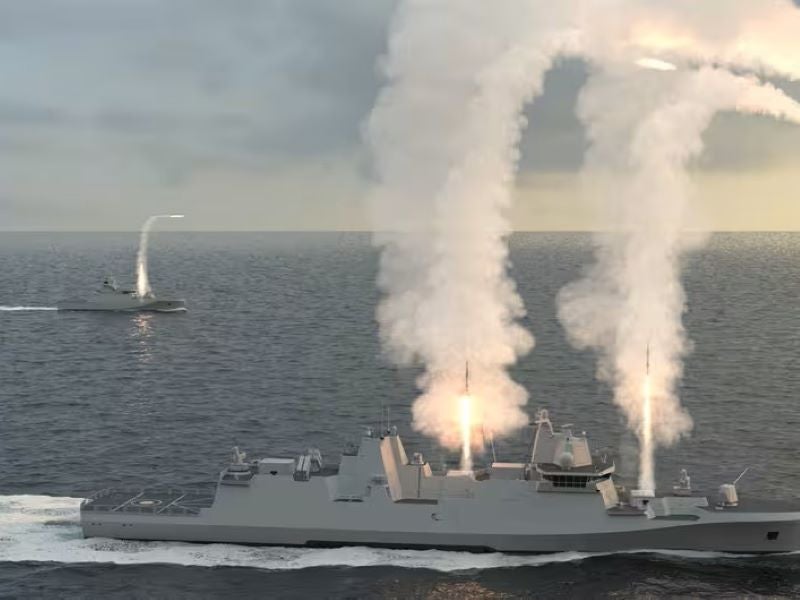
The Guided Missile Frigate (GMF) 140 is a next-generation frigate designed to deliver a broad set of capabilities across the full spectrum of modern naval warfare.
Developed by German automotive and arms manufacturer Rheinmetall, the vessel is intended to meet the requirements of Nato and partner navies seeking an interoperable surface combatant that balances capability with cost-effective acquisition.
Recommended White Papers

Recommended Buyers Guides

The concept reflects the priorities of fleets being modernised to address evolving security challenges across Europe, the North Atlantic and the Indo-Pacific.
Unveiled in August 2026, the vessel is intended for export markets, with Rheinmetall planning to initially put the frigate forward through a North American procurement programme.
GMF 140 design and features
The GMF 140 will measure 140m (460ft) long, with a displacement of 6,000 tonnes (t) and a top speed of 30 knots. It is designed for a core crew of 90 and includes additional accommodation for 35 personnel.
The frigate is described as a multi-domain combatant with a low-signature hull and integrated acoustic management. It is intended to undertake anti-air warfare (AAW), ballistic missile defence (BMD), anti-submarine warfare (ASW) and long-range strike missions.
Optimised for blue-water operations, the vessel is also intended to remain adaptable for expeditionary, littoral and coalition tasks, and to support the embarkation of US or European maritime helicopters alongside uncrewed systems.
Sensors and radars onboard GMF 140
The vessel will be equipped with a US-sourced air defence radar for the detection, tracking, and engagement of conventional air threats and hypersonic weapons, including a variant capable of providing full ballistic missile defence tracking.
It will also be equipped with electro-optical and electronic warfare (EO/EW) suites, plus towed and hull-mounted sonar.
GMF 140’s armaments
The GMF 140 will be equipped with a vertical launch system (VLS) featuring 64 strike-length VLS cells. It will be compatible with a full range of air defence, ballistic missile defence and land-attack missiles.
The wider weapons and sensor fit for the vessel comprises an anti-ship missile capability, torpedo launchers and a 5in main gun, alongside a laser, secondary armament, close-in weapon system (CIWS) and decoy systems.
GMF 140 combat system
For combat management, the GMF 140 will be fitted with Lockheed Martin’s Aegis combat system, along with their CMS330 integrated where required.
Comprising the Aegis weapons system and Aegis ballistic missile defence system, the combat platform is operated by the US Navy and six allied nations, integrating sensors and weapons to support concurrent air and missile defence operations.
The Aegis weapon system provides an automated command-and-control (C2) and weapons-control framework spanning the engagement chain from detection to intercept while the Aegis ballistic missile defence system combines sensors, interceptors and C2 as a sea-based element of the wider ballistic missile defence architecture.
Originally developed for the Royal Canadian Navy, the CMS330 has been used in Canadian, international and Nato maritime operations. It is built around an open-architecture approach intended to integrate third-party capabilities and is designed to fuse sensors, information systems and effectors to improve situational awareness and support decision-making during multi-mission activity.
