

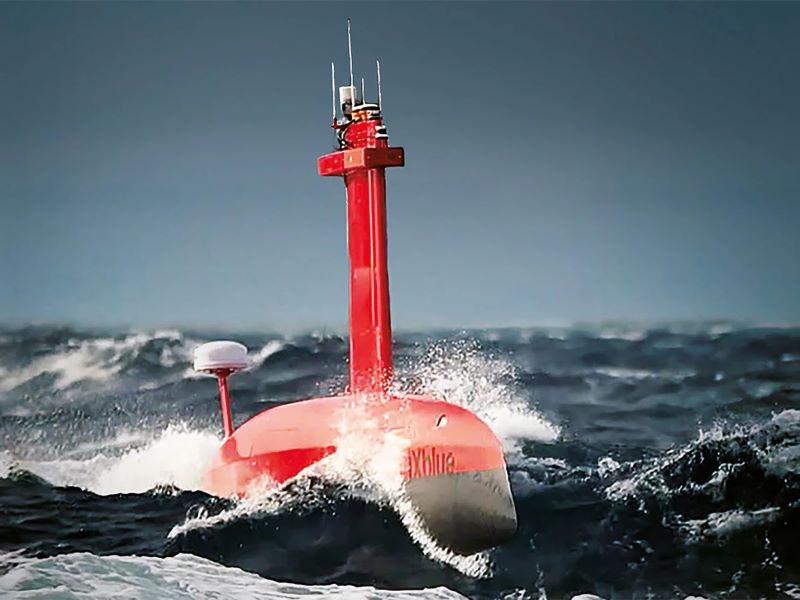
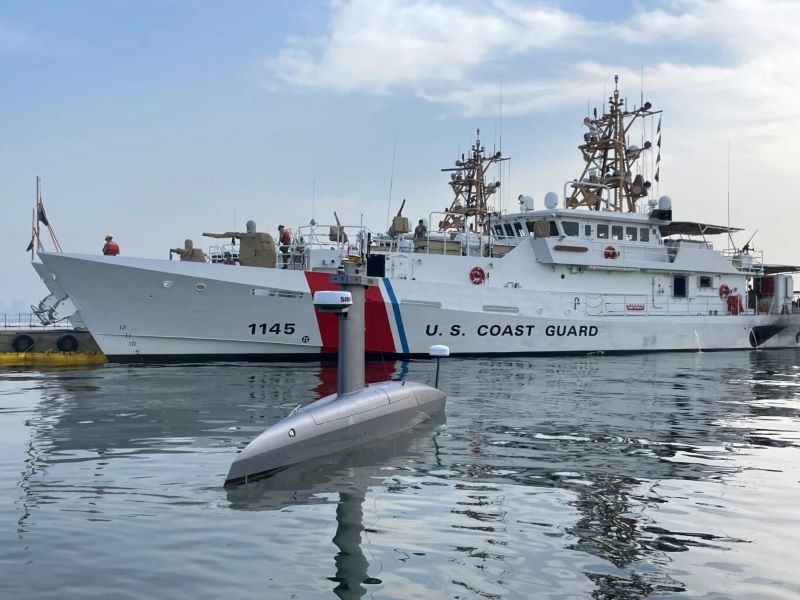
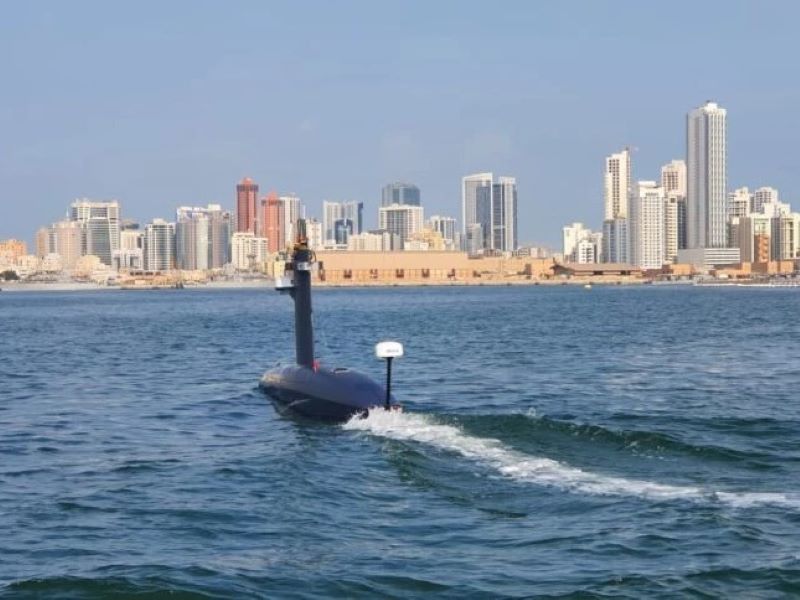
The DriX H-8 is a medium-range uncrewed surface vessel (USV) produced by Exail (previously iXblue) and is part of the wider DriX family.
It is designed for both remotely controlled missions and supervised autonomous operations, with an emphasis on stable performance and reliable data collection in shallow and deep-water environments.
Recommended Buyers Guides

DriX was launched in 2017 and is the first USV to receive certification from both Bureau Veritas and Lloyd’s Register.
The USV has participated in various exercises conducted by major naval forces including the US Navy and the French Navy. It has also demonstrated its performance in multinational trials and exercises such as NATO REPMUS and Task Force X.
DriX H-8 design and features
The DriX H-8 measures 7.7m (22.9ft) in length, 0.8m in width and weighs 1,380kg (3042.4lb). It has a draught of 2m and a displacement of around 1.4t.
It uses a hydrodynamic monohull with a drop keel intended to improve balance and reduce vessel motion, supporting sensor performance.
The hull is a composite structure produced using vacuum infusion with Kevlar reinforcement, making the vessel lighter than vessels made from marine steel or aluminium. As a result, the USV consumes less fuel, has a lower greenhouse gas emissions profile and produces less radiated noise in the water.
The design enables the USV to pierce waves and prevent capsize, even in high sea states. The platform is designed to operate up to Sea State 5 and is built to accept a range of reconfigurable payloads.
The vessel also includes an underwater gondola for payload deployment, with a computational fluid dynamics optimised form intended to reduce acoustic effects and minimise bubble interference. A dedicated launch and recovery system is also available.
Launch and recovery system details
The DriX H-8 Deployment System (DDS) is designed to enable rapid and secure launch and retrieval operations in conditions up to Sea State 3. Drawing on a rigid-hulled inflatable boat-style form and using one or two lift points, the DDS can be handled via a davit, crane or A-frame.
Its modern design also supports fully automated docking of the DriX H-8 within the DDS without operator involvement. This auto-docking function is underpinned by the continual sharing of position data between the DriX H-8, using its integrated global navigation satellite system (GNSS) and Phins C7 inertial navigation system, and the DDS, which uses its own GNSS and Quadrans attitude and heading reference system.
DriX H-8 payload options
Payload configurations for the vessel can be tailored to mission needs and can include multibeam and single-beam echo sounders, sub-bottom profilers, and the FlipiX remotely operated tow vehicle to support side-scan sonar and magnetometer tasks.
Additional payload options include ultra-short baseline (USBL) and long baseline (LBL) positioning systems, acoustic modems, an acoustic doppler current profiler, sound velocity probes, and conductivity, temperature, depth sensors.
The USV can also be equipped with turbidimeters, fathometers, hydrophones, and mission sensors such as LiDAR, radar and cameras.
Engine and performance
Propulsion is provided by a 38hp diesel engine driving a single straight shaft with a fixed-pitch propeller. The USV has a fuel capacity of 250 litres, with a stated average consumption of around two litres per hour.
The vessel is capable of speeds of up to 14 knots, with an endurance of seven days at seven knots and up to ten days at four knots, while operations at maximum speed can be maintained for up to 24 hours.
Command and control
Equipped with a sophisticated collision‑avoidance suite and a follow me mode, DriX H-8 can cover wide maritime areas at speed while maintaining station astern of the Mother Vessel.
Communications are provided via a multi-channel architecture intended to support line-of-sight and beyond-line-of-sight connectivity.
The DriX H-8 supports both direct remote operation and supervised autonomy. In supervised autonomous mode, the vessel carries out its tasking independently, with an operator monitoring progress either within line of sight or at extended range (over the horizon).
The USV’s autonomy functions are enabled through Exail’s CortiX software framework, which covers mission execution, navigational safety, onboard data management and beyond-line-of-sight operations via a web-based interface that can be deployed at the edge or through cloud infrastructure.
The framework includes modules for mission planning and execution, health monitoring, data handling and communications management, with an application programming interface available to support integration with third-party software.
DriX H-8 applications
Operational roles for the DriX H-8 include military bathymetric survey work, rapid environmental assessment and support tasks linked to anti-submarine warfare, as well as use in emergency and disaster response.
The DriX H-8 can undertake tasks in nearshore environments as shallow as 4m, using a variety of shallow-water MBES.
It is also suited to deeper offshore work, supported by autonomous underwater vehicle tracking and communications enabled by Exail’s Gaps USBL and Canopus LBL systems. The platform can additionally be configured to integrate selected third-party equipment.
Exail is also developing an upgrade intended to extend the DriX H-8’s shallow-water capability to around 3m depth by cutting the vessel’s draught to approximately 90cm, while retaining MBES functionality.
Orders and deliveries
In June 2025, Exail announced a defence contract with an undisclosed European customer for five DriX H-8 vessels for intelligence, surveillance and reconnaissance tasks, aimed at improving maritime awareness and supporting the protection of key sea routes.
