
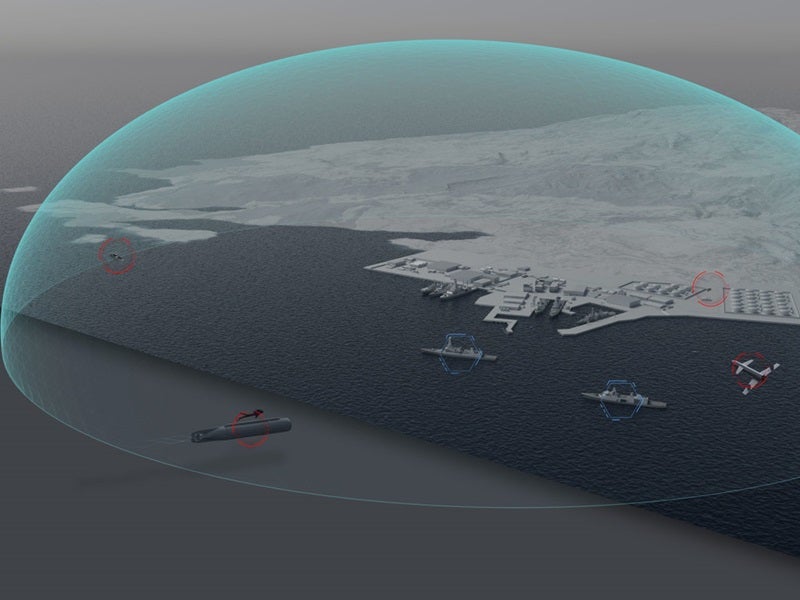

NiDAR is a counter‑unmanned aircraft system (CUAS) developed by MARSS Group, a Monaco‑based defence technology company.
The CUAS is designed to address the growing threat posed by unmanned aerial systems (UAS), ranging from micro platforms to larger tactical drones, including Class I and II.
Recommended Buyers Guides

It enhances the ability of military and security personnel to quickly and efficiently detect, identify, track and neutralise UAS threats located more than 25km away.
MARSS completed the installation of two NiDAR CUAS at two major naval bases within the Gulf Cooperation Council (GCC) in the first quarter of 2025.
NiDAR counter‑unmanned aircraft system design and features
NiDAR CUAS combines state-of-the-art sensors with multiple surveillance and intelligence streams to deliver real-time situational awareness.
It is fully modular and sensor‑agnostic, allowing integration with existing infrastructure as well as the latest sensor technologies.
These multi‑domain inputs are consolidated into a single tactical picture and managed via an intuitive command‑and‑control (C2) interface.
The system supports centralised communications with both remote and local operators and is available as two fully integrated mobile platforms in the form of national and mobile C2 units.
NiDAR CUAS capabilities
The NiDAR C2 suite integrates radar and radio‑frequency (RF) monitoring to detect objects across land, surface and air domains, while live contact displays and detailed sensor diagnostics enable operators to observe, track and protect assets.
The company’s proprietary proprietory AI system draws on sophisticated algorithms, video analytics, behavioural‑pattern recognition, object metadata, historical event analysis and RF signal monitoring to detect, classify and identify objects. It also utilises a range of environmental inputs, including weather conditions, geographic location and flight timetables.
AI‑driven threat recognition analyses movement patterns against a library of more than 1,000 known objects, ensuring operators are alerted only to consequential events.
Through machine learning, the system becomes more effective over time, recording UAS speed, approach vectors and manoeuvrability for future reference.
NiDAR’s intuitive user interface connects to a range of countermeasures, including RF and GPS jamming and kinetic options for the decisive defeat of threats. Both kinetic and non‑kinetic effectors are available, with engagement of targets at ranges of up to 6km.
The countermeasure suite can be expanded as threats evolve and operational needs change.
Radar detection abilities of NiDAR CUAS
Omnidirectional coverage is achieved by four fixed arrays, each providing 90° azimuth and 90° elevation. The modular radar family includes several models, offering ranges of roughly 30km for smaller variants and substantially greater distances for larger configurations.
Optimised for the detection of small contacts, the radar delivers high resolution with low Doppler thresholds and employs AI‑based automatic classification to differentiate birds and clutter from genuine targets.
Operating in the S‑band frequency, it uses passive cooling and is rated for continuous operation in ambient temperatures from −40°C to +55°C.
Model S typically offers detection ranges of around 15km for Category 2 (CAT 2) contacts and up to 50km for transport aircraft.
Model M extends to around 25km for CAT 2 contacts and approximately 100km for transport aircraft, while Model L provides ranges on the order of 80km for CAT 2 contacts and roughly 200km for transport aircraft.
C2 integration for the NiDAR CUAS enables automatic radar contact verification, confirming and cross‑referencing detected targets to reduce false alarms. Automatic Dependent Surveillance–Broadcast (ADS‑B) database checks provide rapid validation against historical transmissions and a chronological record of an aircraft’s ADS‑B activity.
RF detection suite details
The RF detection suite delivers 24/7 protection without requiring calibration, specialist signal expertise or operator training.
Leveraging RF inputs for precise, targeted jamming, the NiDAR CUAS has been technically proven to detect and counter around 98% of common drone types. The standard package monitors 2.4GHz, 5.8GHz and Wi‑Fi, while an extended option adds 433MHz, 868MHz, 915MHz and 1.2GHz.
Typical detection ranges reach 3km horizontally and 1,500ft vertically, although actual performance depends on the noise floor and local environment.
The antenna suite includes omni-bifilar and quadrafilar receivers, a dual‑band transmitter, dual TX/RX Wi‑Fi capability and a GPS receiver.
AI electro‑optical verification capabilities of NiDAR CUAS
C2 integration provides automatic slew‑to‑cue with full command and control linkage, removing the need for operator intervention. NiDAR’s AI image classification assigns each object to one of 17 categories, including bird, UAV, helicopter, airliner, tank and truck.
The system supports day‑and‑night operations, using a cooled high‑definition infrared sensor for continuous 24/7 performance. Gyro‑stabilisation maintains effectiveness in high winds and on unstable platforms.
The daylight payload is a five megapixel high‑definition imager with continuous zoom. The infrared core is a cooled mid‑wave infrared (MWIR, 3-5µm) thermal imager with a resolution of 1,280 × 1,024 pixels.
