

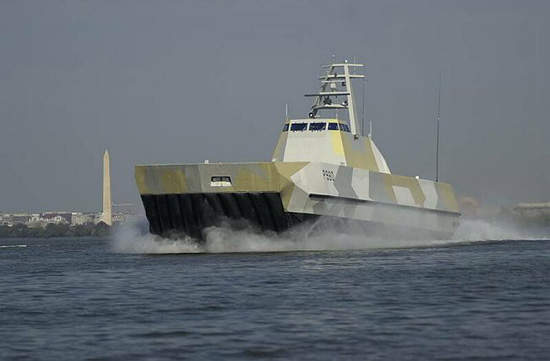
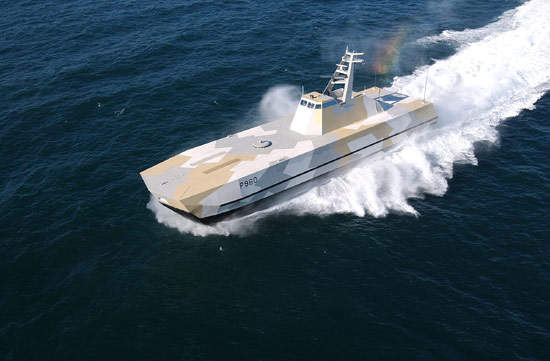
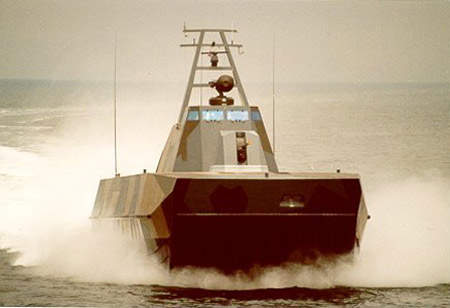
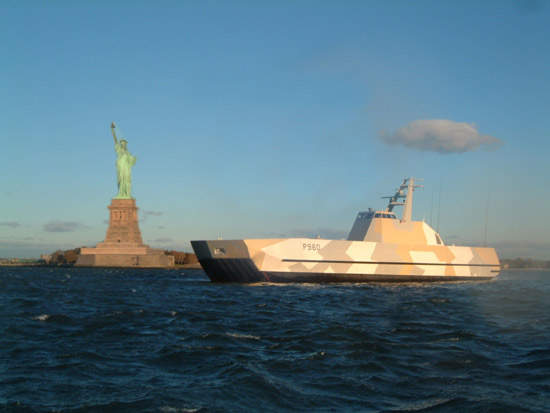
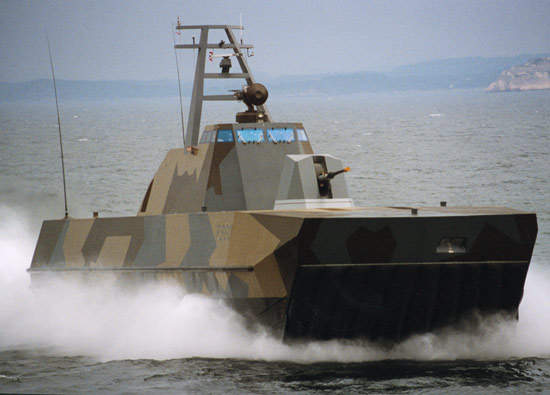
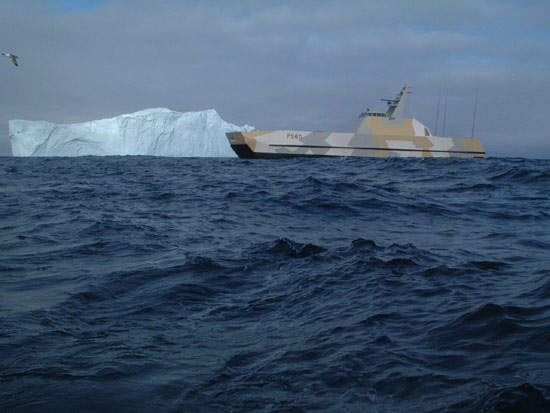
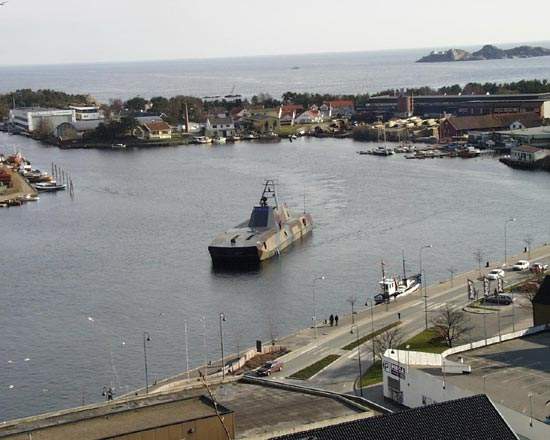
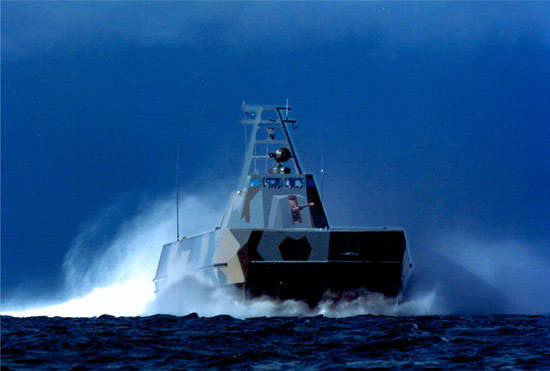
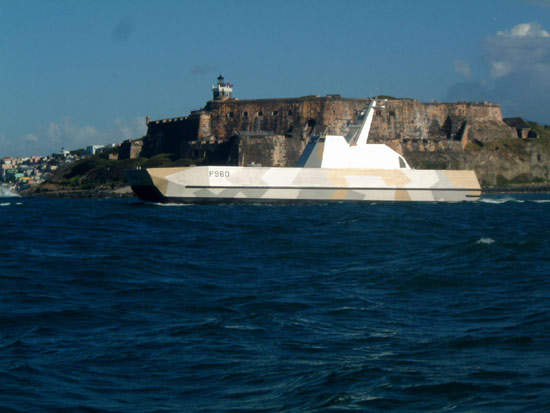
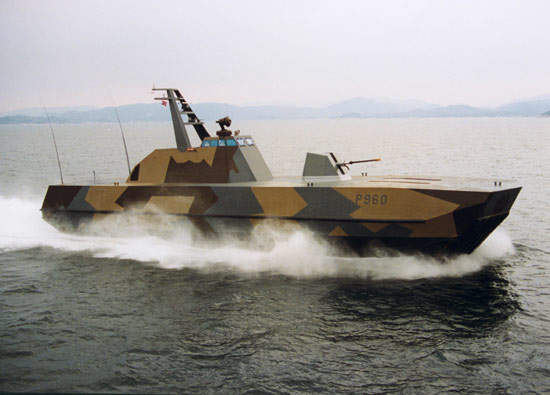
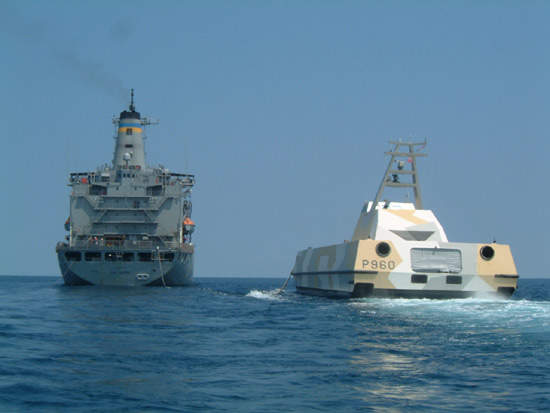
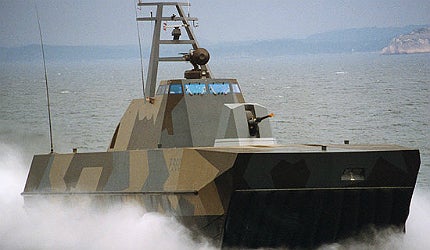
The Skjold Class missile fast patrol boat is characterised by its speed, reduced signatures, small size with heavy weapon load and its littoral combat capability. The Skjold (‘shield’) has an air-cushioned catamaran hull (surface effect) which, with waterjet propulsion, provides high speed and manoeuvrability.
Recommended White Papers

Recommended Buyers Guides

The first-of-class ship, KNM Skjold (P960), was commissioned in April 1999. The Norwegian Government approved the construction of five more Skjold Class vessels in June 2002. Contract negotiations were concluded in July 2003. The series of ships were constructed at the Umoe Mandal shipyard.
The other five hulls are: Storm (P961), Skudd (P962), Steil (P963, launched January 2008), Glimt (P964) and Gnist (P965). Storm (P961) was launched in November 2006 and started sea trials in January 2008.
In September 2002, Skjold completed a 13-month deployment in the US, allowing the US Navy to study the Skjold Class concept. The ship participated in a series of naval exercises and a number of tests with US Navy research establishments NAVSEA and the Office of Naval Research.
This was the result of a bilateral agreement in which the US Navy reviewed the Skjold capabilities and performance as part of their transformational activities, including littoral combat ship (LCS) development.
In September 2003, Skjold was temporarily decommissioned and returned to the Mandal shipyard for the upgrading of its propulsion system. The vessel began sea trials in November 2006, prior to recommissioning in mid-2008. Skjold has been redesignated as a trials platform.
The second ship in class, Storm (P961), was delivered in September 2010. Skudd (P962) was delivered in October 2010. Steil (P963) was delivered in June 2011. The fifth ship in the class, Glimt (P964), was handed over to the Royal Norwegian Navy in March 2012. The last ship in class, Gnist (P965), was delivered to the Royal Norwegian Navy in November 2012.
Covert operational capabilities
An important capability of the Skjold is its covert operational capability in littoral warfare, particularly in using Norway’s coastal topography with its islands and fjords, to carry out surveillance and engage hostile forces from a close distance while remaining undetected.
The shallow draught of 0.9m to 2.3m allows the ship to access very shallow waters denied to other vessels.
Air cushion catamaran (ACC) design
The ship’s configuration uses an air cushion catamaran (ACC) design, which is an advanced variant of surface effect ship (SES) technology.
The ACC is based on a catamaran hull with an air cushion between the hulls, which has been successfully proven with the Norwegian Oksoy Class minehunters and minesweepers, which entered service in 1994. The low area of wetted surface of the hulls gives an improved level of shock resistance and significantly reduced wave resistance, compared to that of a conventional displaced or semi-displaced hull configuration.
VT Maritime Dynamics provides the vessel’s stabilisation systems, including a ride control system which monitors and regulates the pressure of the air cushion by controlling vent valves and a stern fan system that controls the stern seal pressure. The elevated position of the magnetic components reduces the magnetic signature.
The combination of the twin hull and water jet propulsion provides very high and very responsive manoeuvrability. Vital systems have been duplicated for enhanced survivability and the ship remains operational with one engine room set lost.
The low draught of 0.9m on cushion gives an advantage of access to shallow coastal waters and lower vulnerability to impact against surface or tethered mines or other debris.
The hull is of composite construction. The hulls are laminated inside and outside with fibre-reinforced plastic composed of glass fibre and carbon laminates bound with vinyl ester and polyester resin. A scrimp manufacturing process is used in construction, involving vacuum-assisted resin injection.
Carbon fibre and carbon-loaded materials have been selected for the beams, mast and supporting structures, which need high tensile strength, for example the support structures for the gun and the electro-optical and radar weapon director.
Radar-absorbent doors, hatches and windows
Radar-absorbent materials have been used in the load-bearing structures across large areas of the ship. This strategy leads to significant weight saving compared to conventional construction techniques of applying RAM cladding to the external surfaces.
The ship’s profile has a faceted appearance with no right-angle structures and few orientations of reflective panels.
Doors and hatches are flush with the surfaces and the windows are flush without visible coaming (edge of window aperture) and are fitted with radar-reflective screens.
Senit 2000 combat management system
The command and control system for the six Skjold Class vessels is the lightweight Senit 2000 combat management system, jointly developed by DCNS and Kongsberg Defence and Aerospace.
The system has also been selected for the modernisation of the Royal Norwegian Navy’s Hauk Class fast patrol boats.
The Senit 2000 combat management system uses operating modes for littoral warfare and is interoperable with tactical datalinks 11 and 16, to be supplied by Aeromaritime. Senit 2000 gives fast response to pop-up air threats, such as helicopters or other aircraft that suddenly emerge from cover.
Weapons of the Skjold Class missile fast patrol boat
The ship is armed with eight Kongsberg NSM (Nye Sjoemaals Missiler, or Norwegian strike missile) anti-ship missiles, which have been developed for the Skjold Class ships and for the Fritjof Nansen frigates.
The NSM missile is equipped with GPS midcourse and a dual-band imaging infrared seeker guidance and has a range in excess of 150km. NSM entered serial production in June 2007.
The ship’s short-range surface-to-air missile is the infrared-guided MBDA Mistral in a portable configuration. A twin launcher will be deployed on the deck or on a land site. The missile is armed with a three kilogram warhead and has a target range of four kilometres.
The ship’s gun, for deployment against aircraft and other vessels, is the Oto Melara 76mm Super Rapid. The gun has a burst-firing rate of 120rpm, firing six kilograms shells to a range of 16km.
Sensors and countermeasures of Norway’s Skjold Class vessels
The Saab Systems Ceros 200 radar and optronic fire control system provides fire control for missiles and guns. The Ceros 200 system includes a Ku-band radar target tracker, CCTV camera, thermal imager, video tracker and laser rangefinder.
Thales Naval France had been awarded the contract for the MRR-3D-NG G-band multirole radar and associated IFF systems.
The MRR-3D-NG radar has a lightweight phased array antenna and operates as both surveillance radar and a self-defence system sensor, with automatic mode switching.
In surface surveillance mode, the MRR-3D-NG can detect low and medium-level targets at ranges of up to 140km and in long-range 3D air surveillance mode targets up to 180km; in the self-defence mode, it can detect and track any threat within a radius of 60km.
The CS-3701 tactical radar surveillance system (TRSS), from EDO Reconnaissance & Surveillance Systems of Morgan Hill, California, provides electronic support measures (ESM) and radar warning receiver (RWR) functions. The system’s 360 degree circular array interferometer antennas are produced by EDO Antenna and Technologies of Deer Park, New York.
Skjold vessels are equipped with the MASS (multi-ammunition soft-kill) decoy system from Rheinmetall Waffe Munition (formerly Buck Neue Technologien) of Germany. MASS can launch up to 32 omni-spectral projectiles in a time-staggered configuration against anti-ship missiles and guided projectiles. The MASS decoy covers radar, infrared, electro-optic, laser and ultraviolet wavebands.
Gas turbine (CODAG) propulsion engines
The main propulsion is by waterjet, which offers very shallow draught and extraordinary manoeuvring capabilities.
The waterjets are normally driven by gas turbines but may also be driven by small diesel engines in order to reduce infrared signature. The waterjet nozzles can be moved independently to manoeuvre the Skjold sideways without side propellers or bow propellers. The Skjold retains its ability to turn through very sharp angles, even at high speeds.
The prototype has a CODAG (combined diesel and gas turbine) propulsion system, with two Rolls-Royce Allison 571KF gas turbine engines, each rated at 6,000kW (8,160hp), driving two Kamewa water jets and two auxiliary engines, MTU 6R 183 TE52 rated at 275kW. These provide a maximum speed of more than 100km/h (55kt).
The new series of Skjold Class ships have COGAG (combined gas turbine and gas turbine) propulsion and are fitted with four gas turbines from Pratt & Whitney, two ST18M rated at two×4,000kW and two ST 40M rated at two×2,000kW, driving the two Kamewa water jets. There are also two MTU 6R TE92 manoeuvring engines, rated at 3,700kW. KNM Skjold has been refitted with this propulsion system.
Two MTU 12V TE92 lift fan engines, rated at 735kW, drive the air into the air cushion between the hulls.
A computer controlled ride control system controls the air cushion at a 0.5m water column pressure.
Global Naval Surface Combatants and Warfare Systems Market 2011-2021
This project forms part of our recent analysis and forecasts of the global naval surface combatants and warfare systems market available from our business information platform Strategic Defence Intelligence. For more information click here or contact us: EMEA: +44 20 7936 6783; Americas: +1 415 439 4914; Asia Pacific: +61 2 9947 9709 or via email.
Related content
Holland Class Offshore Patrol Vessels, Netherlands
Holland Class offshore patrol vessels (OPVs) are being built by Damen Schelde Naval Shipbuilding for the Royal Netherlands Navy.
Nansen Class Anti-Submarine Warfare Frigates, Norway
The five Nansen Class anti-submarine warfare frigates were built by Navantia of Spain for the Norwegian Navy.
Littoral Combat Ship (LCS), United States of America
The littoral combat ship (LCS) is the first of a new family of surface ships for the US Navy.
