
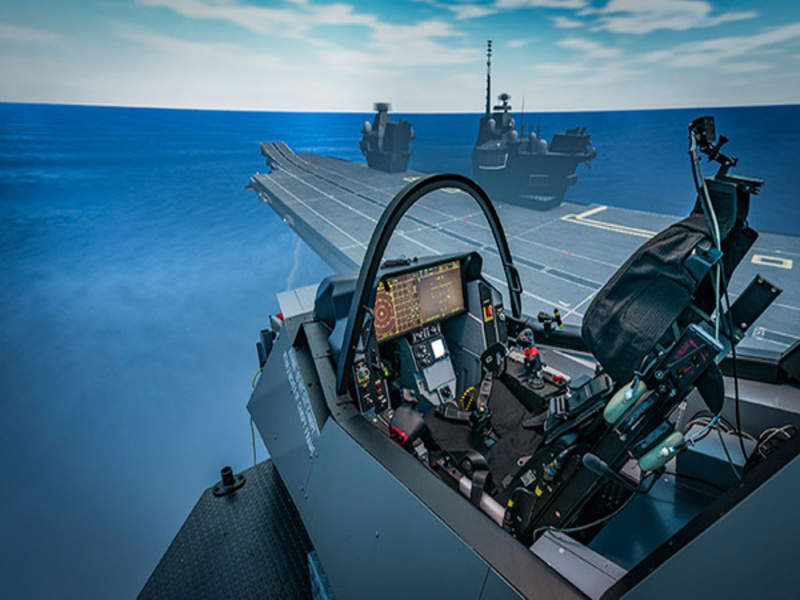

BAE Systems has developed a new F-35 Lightning II flight simulator facility to allow pilots to prepare for trials on the British Royal Navy's new Queen Elizabeth-class aircraft carrier.
The £2m simulator facility provides an immersive experience for pilots to practice take off and aircraft landing on the Queen Elizabeth-class aircraft carrier under challenging sea and weather conditions.
Go deeper with GlobalData


Discover B2B Marketing That Performs
Combine business intelligence and editorial excellence to reach engaged professionals across 36 leading media platforms.
The simulator's 360° view will help test the skill of the pilots, as well as enable them to identify potential obstacles on an aircraft carrier that are often behind the pilots as they land.
It also features a cockpit moved by an electronic motion platform and a full representation of the vessel’s flying control tower (FLYCO), where the ship’s aviation operations will be a controlled by an on-board landing signal officer.
BAE Systems F-35 Programme short take-off and vertical landing variant test pilot Peter Wilson said: “The immersive experience is as near to the real thing as possible. The data will show us exactly what will happen when F-35 pilots fly to and from the Queen Elizabeth carriers.
“The trials we can run through the simulator are far more extensive than what we will do in the actual flight trials because we can run and re-run each trial until we have all the data we need.
“The simulator provides greater cost efficiency for the overall programme, and is extremely important to the success of the first flight trials.”
Flight trials for the first-of-class HMS Queen Elizabeth aircraft carrier are set to begin in 2018.
The pilots will practise a wide range of ski jump short take-offs and vertical landings, which use the vertical thrust from the jet engine and aerodynamic lift from the wings.
This enables the aircraft to take-off and land on the vessel with enhanced weapon and fuel loads compared to its predecessor aircraft.
BAE Systems' simulator will be used over the coming months by both UK and the US military test pilots who have experience of flying F-35s on US Navy carriers.
Image: A F-35Queen Elizabeth-class simulator. Photo: courtesy of BAE Systems.


